from basic to advanced level Modules used in Electronic and Robotics sytems
An electronic modules are build in circuit boards which are designed to perform a specific fuction. The electronic Modules are used to make projects easier, faster, and more reliable by providing a complete functional circuit instead of requiring the user to build every component from scratch.
Here are some special kind of electronic modules which are widely used in Robotics and electronic Projects.
Communication
Power sypply
Relay Module
Motor Driver
Display Module
Power Supply
Sensor module
Measurement
Storage Module
GPIS Module
Description About Commanly Used Electronic Modules
Communication Modules
Communication modules enable electronic and robotic systems to exchange data with other devices through wired or wireless connections.Communication between multiple electronic devices can be achieved using Wi-Fi, GSM, LoRa, and Ethernet modules. With the help of specially designed circuits or modules we can be able to exchange the data between multiple devices.
Common examples of communication modules HC-05, HC-06 Bluetooth module, ESP8266 Wi-Fi and NRF24L01 Wireless Module
Motor Driver Module
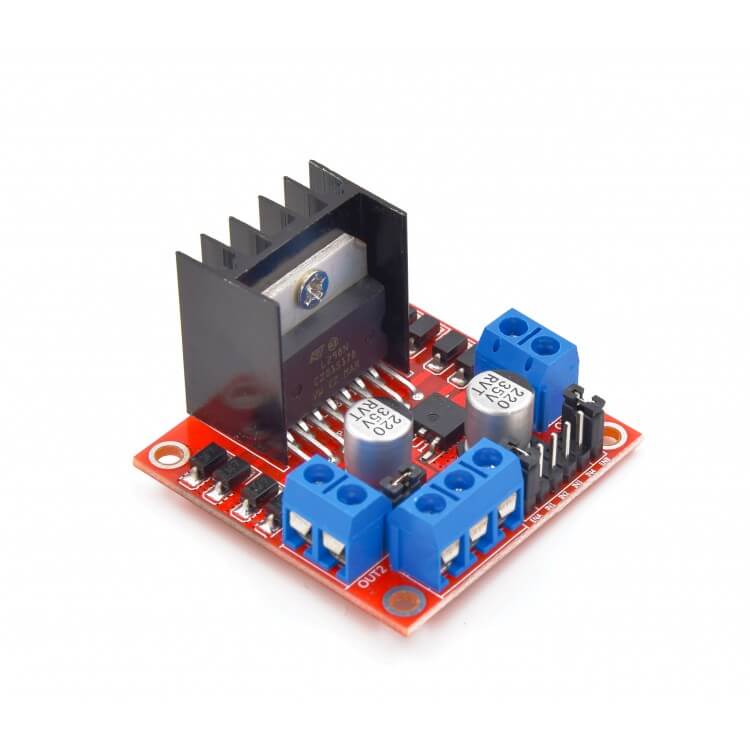
Motor driver modules are used to control motors speed and directions by providing the required current and voltage with the help of microcontroller. Common examples include L298N, L293D, TB6612FNG, and BTS7960. These Motor drivers are Widely used in robotic vehicles, robotic arms, conveyor systems,Line following Robotes and other automation projects.
Relay Module
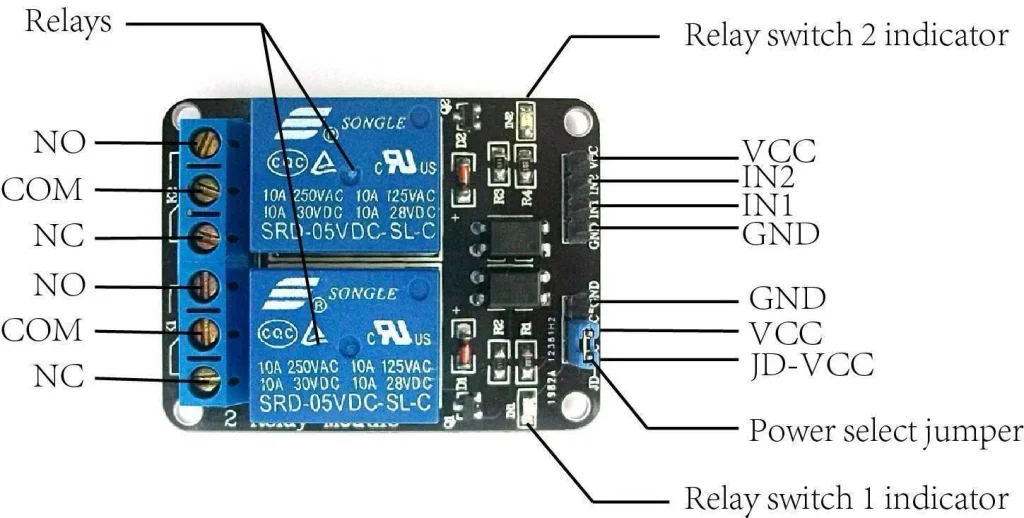
Relays Create a Contact Between AC and DC Power and it allows low voltage control systems i.e. Arduino and ESP32 to switch higher-voltage electrical loads (AC 220 Load).. These are used to control AC Devices with DC devices such as AC-lamps controling with remote, Water pumps, Ac fans, motors, and other appliances. Relay modules are commonly used in home automation, industrial control, and electrical switching applications.
Power supply Module
Sometimes our system requires a specific and continuous voltage without any voltage drop. In such situations, managing the voltage can become difficult. To overcome these challenges, we use specially designed circuit boards or modules that help regulate the voltage.
These types of devices include Buck Converters, Boost Converters, Buck-Boost Converters, Voltage Regulators, and Battery Charging Modules. These modules help provide stable and suitable voltage and current to microcontrollers, sensors, motors, and other electronic components.
Display Module
Display modules are used to Display the Information on Screen such as sensor readings, messages, measurements, and system status to the user. Examples include LCD, OLED, TFT, seven-segment, and LED matrix modules. They are commonly used in measuring instruments, control systems, robots, and monitoring projects.
Sensor Modules
Sensor modules works as an eyes, ears and nose of a Robotics system that detect physical or environmental conditions and convert them into electrical signals which is processed by a microcontroller.
Here are Commonly used Sensors.
- Temperature Sensor
- IR sensor
- Humidity Sensor
- Voltage Sensor
- Ultrasonic sensor
- Humidity Sensor
They are widely used in automation, robotics, security, and Embedded system .
Audio modules
Audio modules are used to detect, record, process, amplify, or produce sound in electronic systems. Examples include microphone modules, sound sensor modules, audio amplifier modules, buzzers, and MP3 player modules. They can be used in alarms, voice-controlled systems, robots, and interactive electronic projects.
Measurement module
Measurement modules are designed to measure electrical or physical quantities such as voltage, current, power, temperature, pressure, and energy. Examples include voltage sensor modules, ACS712 current modules, INA219 modules, and energy-monitoring modules. They are useful for testing, monitoring, protection, and data-logging applications.
RFID & Identification Modules:
RFID and identification modules are used to identify and authenticate objects, cards, tags, or users. RFID modules such as RC522 can communicate with RFID cards and tags without physical contact. These modules are commonly used in access-control systems, attendance systems, smart locks, inventory management, and security projects.
Storage Modules:
Storage modules provide a way to save data generated by sensors, controllers, and other electronic systems. Common examples include SD card and microSD card modules, EEPROM modules, and flash memory modules. They are useful for data logging, storing configuration information, recording measurements, and saving project data.
Camera & Vision Modules:
Camera and vision modules capture images or video for applications that require visual information. Examples include ESP32-CAM, Raspberry Pi camera modules, and other camera sensors. They are used in surveillance, object detection, face recognition, machine vision, autonomous robots, and AI-based projects.
GPS & Navigation Modules:
GPS and navigation modules provide location, speed, direction, and other positioning information using satellite signals. Modules such as NEO-6M and NEO-M8N are commonly used in drones, autonomous robots, vehicle tracking systems, navigation projects, and location-based IoT applications.
IMU Module
Inertial Measurement Unit (IMU) modules measure motion and orientation using combinations of accelerometers, gyroscopes, and sometimes magnetometers. Examples include MPU6050, MPU9250, and BNO055. They are widely used in drones, balancing robots, robotic navigation, motion tracking, and autonomous systems.
Logic & Interface Modules:
Logic and interface modules help electronic devices communicate or operate with different signal levels, communication protocols, or input/output requirements. Examples include logic-level converters, multiplexers, I/O expanders, ADCs, DACs, and shift-register modules. They are useful when connecting microcontrollers with sensors, displays, and other digital or analog devices.
Iot Module
IoT modules provide connectivity that allows electronic devices and robots to communicate with networks, servers, or cloud platforms. Wi-Fi, cellular, LoRa, and Ethernet modules are commonly used for this purpose. They enable applications such as remote monitoring, smart homes, industrial automation, connected sensors, and intelligent robotic systems.
Safety & Protection Modules:
Safety and protection modules help protect electronic systems, batteries, and electrical loads from conditions such as overcurrent, overvoltage, short circuits, overheating, and excessive battery discharge. Examples include Battery Management System (BMS) modules, battery protection boards, overcurrent protection modules, and voltage protection circuits. They are important for improving the safety and reliability of electrical, electronic, and robotic projects